


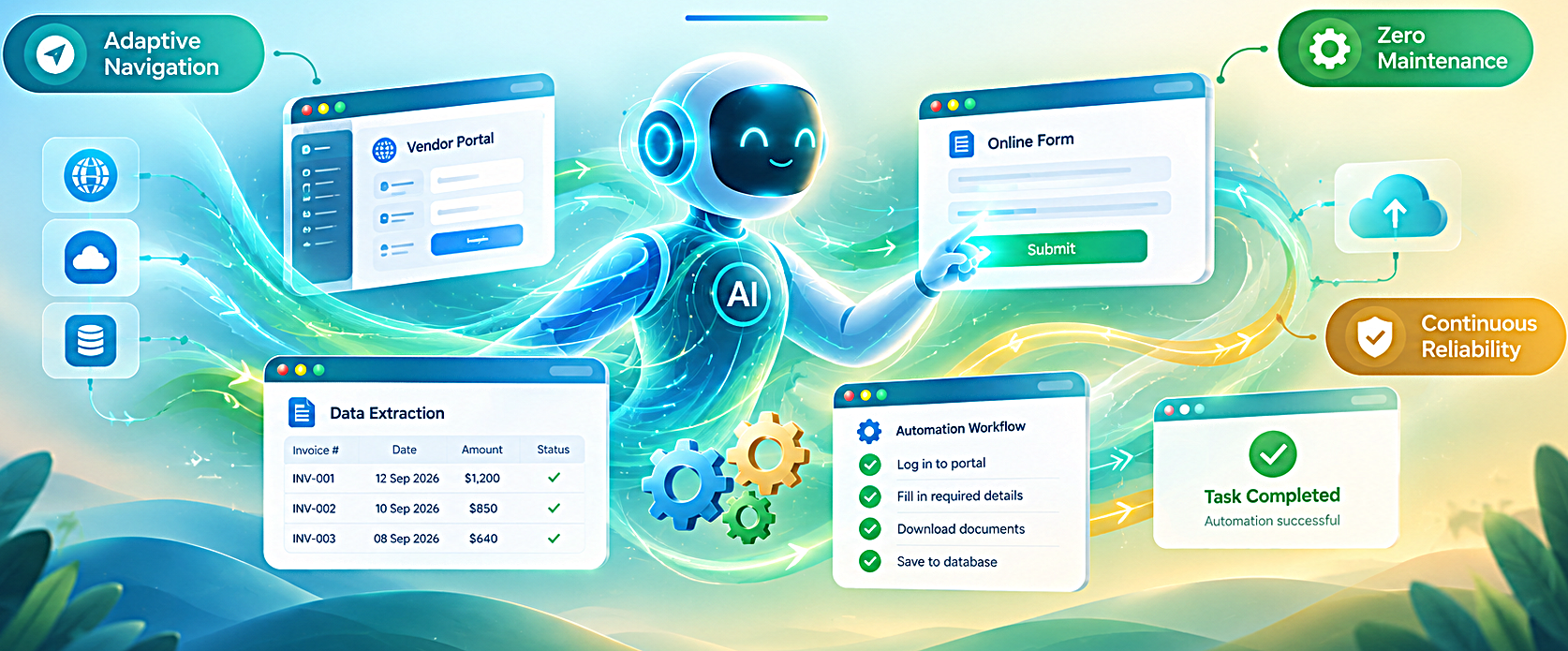
Traditional RPA relies on brittle CSS selectors and pixel-perfect logic. When websites evolve—and they always do—carefully configured workflows fail silently. Organizations end up in constant maintenance cycles, paying steep per-bot licensing fees, and diverting engineering resources from strategy to firefighting.
AI-powered browser automation changes this. Modern AI agents use computer vision and adaptive logic to understand webpage content and navigate dynamically. They recognize form fields by labels, adapt to layout changes, and continue functioning as systems evolve. For organizations managing automation at scale, this is a fundamental shift from fragile to intelligent systems.
Why Traditional RPA Is Becoming Obsolete
- Fragility — Layout changes break workflows. Constant maintenance cycles required.
- High Licensing — Per-bot and per-user fees make scaling expensive.
- Limited Flexibility — Fixed selectors cannot handle dynamic content.
- Slow Deployment — 2-3 months of configuration before first automation.
- Vendor Lock-In — Platform changes require complete workflow rebuilds.
Organizations end up maintaining costly automation that becomes a liability.
The AI Automation Landscape: Three Platforms to Know
- Browser Use — Lightweight, open-source foundation with strong Python SDK. Suitable for rapid prototyping and internal automation projects with flexible deployment requirements.
- Skyvern — Hybrid AI + traditional automation optimized for vendor portals, invoice processing, and complex multi-step workflows. Reduces dependence on fixed selectors and simplifies maintenance across client environments.
- Stagehand — Integrates AI-powered browser actions with Playwright for TypeScript-based solutions. Best suited for organizations requiring both AI adaptability and deterministic automation control within the same workflow.
Strategic Advantages
- Lower Costs — Open-source and cloud models eliminate expensive licensing pass-through.
- Reduced Maintenance — Automation adapts to system changes without human intervention.
- Faster Delivery — Deploy in 2-3 weeks instead of 2-3 months.
- Premium Positioning — Automation shifts from commodity add-on to high-value service.
- Scalable Growth — Add workflows without proportional infrastructure increases.
Real-World Applications
- Invoice Processing — Automate extraction from vendor portals and route to accounting. Continues working through portal redesigns.
- Onboarding — Orchestrate account creation across SaaS platforms. Reduces provisioning cycles from days to hours.
- Compliance — Automated collection of audit logs and security reports on schedule.
- HR Data Sync — Extract employee data with validation against directory services.
- Competitive Monitoring — Track pricing and feature updates across competitors automatically.
- Legacy Integration — Bridge on-premises systems without APIs to cloud systems.
Implementation Approach
- Start with Adaptive Workflows — Target use cases where interfaces change frequently or vendor portals are unpredictable.
- Monitor Continuously — Track agent accuracy with hourly alerts for degradation.
- Hybrid Architecture — Deploy AI agents for navigation, add validation layers for edge cases.
- Graduated Rollout — Maintain fallback processes until agent reliability is verified.
- Document Outcomes — Focus on business objectives, not technical implementation details.
The Business Impact
- 40-60% Reduction in Maintenance — Fewer failed workflows, reduced reactive support.
- 4x Faster Deployment — 2-3 weeks vs. 2-3 months means more projects per year.
- Continuous Reliability — Workflows adapt to system changes without intervention.
- Engineering Capacity Recovery — Redirect 20-30% of resources from maintenance to strategy.
- Improved Margins — Automation shifts from commodity to premium service positioning.
The transition to intelligent, adaptive automation is becoming baseline expectation. Organizations establishing this capability now gain competitive advantage.